Output Impedance Ratio: Why It Matters for IEM Audio

Affiliate disclosure: Some links on this page are affiliate links. If you buy through them we earn a small commission at no extra cost to you. Recommendations are research-driven; we don't claim personal use of every product reviewed. Product prices and availability are accurate as of the date published and are subject to change. Always check Amazon for current pricing before purchasing. Learn more.

Quick Picks
FiiO X5 Mark III Portable High-Resolution Audio Player
Dedicated audio hardware with dual AK4490 DAC chips
FiiO M11 Plus Portable Music Player ESS Version
Android 10 supports current streaming apps , Spotify, Tidal, Qobuz
iFi Audio iFi xDSD Gryphon Portable Bluetooth DAC/Amplifier
Bluetooth aptX Adaptive delivers near-lossless wireless audio
Buy on Amazon| Product | Price Range | Top Strength | Key Weakness | Buy |
|---|---|---|---|---|
| FiiO X5 Mark III Portable High-Resolution Audio Player also consider | $$ | Dedicated audio hardware with dual AK4490 DAC chips | Android version too old for current app support | — |
| FiiO M11 Plus Portable Music Player ESS Version also consider | $$$ | Android 10 supports current streaming apps , Spotify, Tidal, Qobuz | Premium price difficult to justify vs. phone plus good portable DAC | — |
| iFi Audio iFi xDSD Gryphon Portable Bluetooth DAC/Amplifier also consider | $$$ | Bluetooth aptX Adaptive delivers near-lossless wireless audio | Premium price in a portable device that can be lost or damaged | Buy on Amazon |
| Chord Electronics Chord Mojo 2 Portable DAC/Amp also consider | $$$ | Custom FPGA implementation with Chord's proprietary WTA filter | Ball-button interface is unintuitive and confusing for new users | Buy on Amazon |
| EarFun Free Pro 3 ANC True Wireless Earbuds also consider | $ | Qualcomm aptX Adaptive at ~$79 , exceptional codec value | ANC not class-leading , Sony and Bose significantly ahead | Buy on Amazon |
| Sony WF-1000XM5 True Wireless Noise Canceling Earbuds also consider | $$$ | Best-in-class ANC among true wireless earbuds | Premium price; XM4 or XM3 available second-hand at significant discount | Buy on Amazon |
| Apple AirPods Pro 2nd Generation with MagSafe Case also consider | $$$ | Best ANC integration in the Apple ecosystem with system-level compatibility | AAC codec ceiling limits audio quality on non-Apple devices | Buy on Amazon |
| HiBy R3 Pro Saber Portable Music Player also consider | $ | 4.4mm balanced output at ~$129 , exceptional value for balanced portable audio | Screen small and touch interface less responsive than flagship DAPs | Buy on Amazon |
Output impedance ratio sounds like the kind of spec buried in a DAC/amp forum thread that only matters to gear obsessives. Three years in, I’ve learned it matters more than I expected, especially for IEM users pairing sensitive earphones with sources that weren’t designed with them in mind. It’s one of those fundamentals that shifts from abstract to very concrete the moment you hear audible bass bloat or tonal imbalance through a mismatched pairing.
This article covers what output impedance ratio actually means, why it affects frequency response in ways you can measure and hear, and how to use it as a practical filter when evaluating portable sources. For broader context on source chain fundamentals, the Audiophile Basics hub covers everything from DACs to amplifier classes in accessible terms.

What Is Output Impedance?
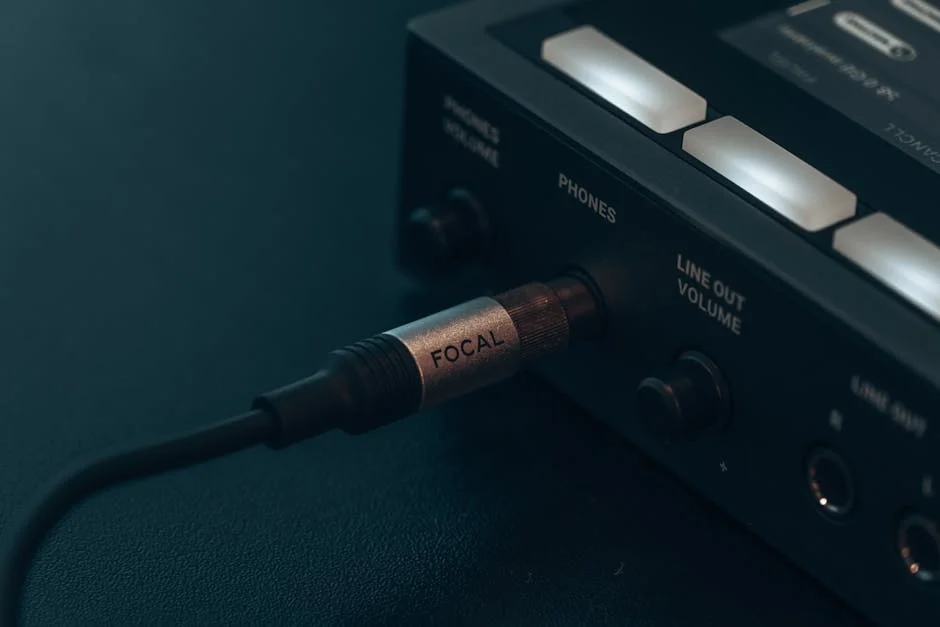
Every amplifier output, whether from a dedicated headphone amp, a DAP, a phone’s headphone jack, or a DAC/amp dongle, has a small amount of internal resistance. That internal resistance is the output impedance, measured in ohms. It’s the electrical “stiffness” of the source, and it interacts directly with whatever load you plug into it.
For speakers and most full-size headphones, output impedance is rarely a concern. But IEMs are a different story. Many IEMs have very low impedance ratings, sometimes in the 8 to 32 ohm range, and multi-driver IEMs with crossover networks show impedance that varies significantly across the frequency range. That variable impedance is where output impedance ratio becomes the relevant concept.
Output Impedance Ratio Defined
Output impedance ratio is the relationship between the source’s output impedance and the headphone or IEM’s impedance. The widely cited rule of thumb in the community is the 1:8 rule: the source output impedance should be no more than one-eighth of the headphone’s rated impedance. So a 16-ohm IEM wants a source with 2 ohms or less at the output. A 300-ohm headphone like my HD600 can tolerate sources with output impedance up to roughly 37 ohms without measurable tonal shift.
The math is straightforward, but the consequences aren’t always obvious until you hear them. ASR’s measurements regularly flag sources with elevated output impedance, and Crinacle’s IEM database includes measured impedance curves that show exactly how much impedance swings across frequency for specific IEMs. My impressions are a complement to those resources, not a replacement.
Why Output Impedance Ratio Affects Frequency Response
When a source with high output impedance drives an IEM with a non-flat impedance curve, voltage divider physics takes over. The output and load impedances form a voltage divider, and wherever the IEM’s impedance rises relative to the source’s output impedance, the IEM receives more voltage. Where the IEM’s impedance drops, it receives less.
For single-driver dynamic IEMs with relatively flat impedance curves, this effect is small. For balanced armature IEMs, which often have steep impedance swings at crossover points, the tonal consequences can be significant. Bass regions may receive a boost or cut. Treble response can shift. The tuning the IEM designer intended assumes a near-zero source impedance, and a source with 10 ohms of output impedance can measurably alter what you hear.
A Concrete Example
Consider a multi-driver IEM rated at 8 ohms nominal with a crossover that causes impedance to peak at 40 ohms around 100 Hz. Pair it with a source that has 10 ohms of output impedance, and that 100 Hz region will see significantly elevated output relative to the rest of the spectrum. Bass emphasis that isn’t on the IEM’s frequency response graph, isn’t in the recording, and isn’t in the amplifier’s distortion profile suddenly appears. It’s not a quality issue with the IEM or the amp in isolation. It’s an impedance ratio mismatch.
For my HD600, this rarely comes up. At 300 ohms with a relatively flat impedance curve, the Topping L50’s output impedance of under 1 ohm is a non-issue at any practical ratio. The rule becomes critical when I’m evaluating portable sources for IEM use.
What Output Impedance Looks Like Across Source Types
Not all source categories are created equal here. Desktop amps built for audiophile use almost universally publish output impedance specs and target sub-1 ohm figures. Portable sources are more variable, and the spec is sometimes omitted from marketing materials entirely, which means relying on measurements from ASR or manufacturer spec sheets.
Smartphone headphone jacks, where they still exist, tend to run between 1 and 10 ohms. Cheap USB-C dongles can range from under 1 ohm on well-designed units to over 3 ohms on budget options. Dedicated DAPs are generally designed with IEMs in mind and target low output impedance, but not universally. Portable DAC/amps vary widely depending on design intent.
Balanced Outputs and Output Impedance
Many portable sources now offer balanced outputs alongside single-ended. Balanced outputs on portable DAPs and DAC/amps can sometimes have different output impedance specifications than single-ended, so checking both is worth the time if you use an IEM with a balanced cable. A source might have under 1 ohm single-ended and still spec low on balanced, but verifying that spec rather than assuming is good practice. The community consensus at ASR and Head-Fi generally favors measuring rather than trusting marketing copy.
Buying Guide: Portable Sources and Output Impedance Ratio
Understanding output impedance ratio changes how you evaluate portable sources. The following factors should anchor any purchasing decision for IEM-focused listeners. If you’re working from first principles on source chain decisions, the core concepts section of Audiophile Basics covers impedance, sensitivity, and gain structure in more detail.
Prioritize Published Specs and Third-Party Measurements
A source that publishes output impedance in its spec sheet is already signaling design awareness. A source that omits the figure requires a detour to ASR’s database or Head-Fi’s measurement threads before committing. For IEM-focused use, target sources with output impedance of 1 ohm or below on single-ended and verify balanced output separately. Mid-range and premium DAPs from FiiO and HiBy generally hit this target, and their spec sheets are reasonably transparent. Budget DAPs may also hit the target but deserve more verification.
Match Source to IEM Impedance Profile, Not Just Nominal Rating
Nominal impedance ratings on IEMs are often measured at 1 kHz and do not reflect how impedance behaves across the full frequency range. Multi-driver IEMs with crossover networks are the highest-risk category for impedance ratio mismatches. Single-driver dynamic IEMs with flatter impedance curves are more forgiving of elevated source output impedance. Checking Crinacle’s impedance measurement data for a specific IEM before pairing it with a new source is a reliable habit. The nominal 16-ohm or 32-ohm figure on the box is a starting point, not a guarantee of matching compatibility.
Consider Gain Structure Alongside Output Impedance
Output impedance ratio solves the frequency response problem. Gain structure solves the noise floor problem. Sensitive IEMs paired with sources designed for high-impedance headphones may have audible hiss at low volume even if the impedance ratio is correct. Low gain settings reduce this, but some sources don’t have adequate low-gain options. Verified buyers of budget DAPs and dongles occasionally report channel imbalance at very low volume steps on sources with limited low-gain design, which is a related but separate issue from output impedance. Evaluate both specs together when the target use case is sensitive IEM playback.
Budget vs. Premium Sources: Where the Spec Gap Actually Matters
At the budget tier, dedicated DAPs often offer better output impedance specs than budget smartphone dongles, even when chip quality is comparable. At premium tiers, the spec differences between sources are small enough that other factors, including form factor, interface quality, Android version support, and battery life, become dominant decision criteria. Output impedance ratio is most useful as a filter at the budget tier, where variation is highest and undisclosed specs are most common. At premium tier, most well-regarded sources have already solved the impedance ratio problem.
Balanced vs. Single-Ended for IEM Listening
The practical benefit of balanced outputs for IEMs is primarily noise floor reduction, not impedance ratio improvement. Balanced outputs can achieve lower noise floors because of common-mode rejection, which matters for sensitive IEMs that reveal hiss easily. The impedance ratio benefit exists only if the balanced output happens to have lower output impedance than the single-ended, which is not guaranteed. Verify independently rather than assuming balanced automatically means better impedance ratio. Several mid-range DAPs spec identical or near-identical output impedance across both output types.
Top Picks: Portable Sources With IEM-Friendly Output Impedance
The sources below represent a range of form factors, price bands, and use cases. Output impedance specs and community measurements are noted where available. For each, field reports from verified buyers and measurements from ASR and the broader community inform the assessment alongside published specifications.
FiiO X5 Mark III
The FiiO X5 Mark III is a mid-range DAP built around dual AK4490 DAC chips with a 2.5mm balanced output. Spec data from FiiO shows output impedance below 1 ohm on the single-ended output, which positions it well for IEM use across most impedance profiles. The dual-chip implementation provides adequate power for both IEMs and moderately efficient full-size headphones without the noise floor penalty that plagues underpowered portable sources.
The significant caveat is software. Android 5.1 is the operating system, and verified buyers consistently report that current streaming apps, including Qobuz and Tidal, either no longer support this Android version or perform poorly due to API changes. Owner reviews frame the X5 III as a strong local file player with a compromised streaming experience. For a listener whose library lives on local storage, field reports indicate the audio hardware holds up well. For anyone prioritizing streaming, the software limitation undermines an otherwise competent audio platform.
Check current price on Amazon.
FiiO M11 Plus ESS Version
The FiiO M11 Plus Portable Music Player ESS Version runs Android 10 and uses an ESS Sabre ES9068AS chip. Published output impedance is below 1 ohm across both single-ended and the 4.4mm balanced output, and ASR’s measurements of related FiiO ESS-based hardware confirm excellent noise floor figures for sensitive IEM use. The 4.4mm balanced output provides meaningful headroom for demanding headphones that occasionally accompany IEM listeners on travel.
Verified buyers highlight Android 10 support as the real differentiator over older DAPs, with current Spotify, Tidal, and Qobuz apps running without compatibility issues. The form factor is notably large compared to competing DAPs at this tier, which is the most common practical complaint in owner reviews. Field reports from Head-Fi and ASR threads indicate that the audio performance is genuinely strong for an ESS-based portable, but the size and premium price require honest evaluation against the phone-plus-dongle alternative for listeners who already carry a recent smartphone.
Check current price on Amazon.
iFi xDSD Gryphon
The iFi xDSD Gryphon is a premium portable DAC/amp with both wired and aptX Adaptive Bluetooth input. iFi publishes output impedance below 1 ohm for IEM use, and owner reviews generally confirm quiet operation with sensitive IEMs. The physical analog volume dial is consistently cited in verified buyer reviews as a practical advantage over app-based volume controls, particularly for IEM listeners making fine adjustments at low volume.
The XBass and XSpace DSP filters add coloration that some users prefer and others keep off entirely. Field reports from audiophile communities are consistent on this: the filters are optional, the baseline sound without them is preferred by most IEM-focused listeners, and the Bluetooth aptX Adaptive implementation is among the better-performing wireless inputs in the portable DAC/amp category. The premium price point for a portable device carries the practical risk of loss or damage that desktop components don’t face.
Check current price on Amazon.
Chord Mojo 2
The Chord Mojo 2 uses a custom FPGA implementation rather than an off-the-shelf DAC chip, and its measured performance from ASR is excellent despite the unconventional approach. Output impedance is specified below 1 ohm, and the measured noise floor is low enough for sensitive IEM use. The FPGA-based WTA filter is Chord’s proprietary approach to digital filtering, and it has generated substantial technical discussion across Head-Fi and Resolve Reviews.
Verified buyers are divided on the ball-button interface. Field reports consistently describe it as unintuitive, with multiple owners reporting confusion during initial setup before adapting. The Poly streaming module, available separately, adds wireless functionality. Owner reviews comparing the Mojo 2 to the original Mojo frequently note that the original remains available second-hand at a meaningful discount with similar audio performance, and the interface changes between versions are not universally seen as improvements. For technically curious audiophiles interested in FPGA audio approaches, the Mojo 2 is a genuinely interesting piece of hardware.
Check current price on Amazon.
HiBy R3 Pro Saber
The HiBy R3 Pro Saber is a compact budget DAP with an ES9219C chip and a 4.4mm balanced output, which is an unusual specification at this price band. Published output impedance is below 1 ohm, and spec data positions it as a credible IEM source at budget pricing. Verified buyers frequently cite the 4.4mm balanced output as the primary reason for choosing it over competing budget DAPs, many of which offer 2.5mm only or no balanced output.
Owner reviews note that the small screen and touch interface are the primary ergonomic limitations. The touch responsiveness is described as functional but noticeably below flagship DAPs. Android support for streaming apps is present but limited by an older Android version, which is a consistent pattern across budget DAPs in this category. Field reports from IEM-focused communities indicate the R3 Pro Saber performs above its price band for audio output quality, particularly on the balanced output with sensitive IEMs.
Check current price on Amazon.
EarFun Free Pro 3
The EarFun Free Pro 3 are budget TWS earbuds with Qualcomm aptX Adaptive, which is a notable codec inclusion at this price band. Output impedance as a spec is less relevant for TWS earbuds because the driver and amplifier are integrated inside the earbud housing, bypassing the source-to-headphone impedance ratio concern that applies to wired sources. Tuning data from ASR and audio review sites shows accurate response, and the active noise cancellation functions at the budget tier without the class-leading performance of Sony or Bose flagships.
Verified buyers flag occasional TWS connection reliability issues, which appear in user reviews across multiple retail platforms. Field reports from budget audiophile communities treat the Free Pro 3 as a benchmark for how much wireless codec quality is accessible at budget pricing in the current market. The aptX Adaptive implementation delivers near-lossless codec performance at a price band that was previously associated with SBC-only audio, and that represents a measurable shift in what budget wireless audio offers.
Check current price on Amazon.
Sony WF-1000XM5
The Sony WF-1000XM5 are Sony’s flagship TWS earbuds with LDAC codec support and best-in-class ANC among true wireless options. The same integrated driver-plus-amplifier architecture applies as with any TWS earbud, so output impedance ratio is not a factor in source pairing for these. LDAC delivers up to 990 kbps over Bluetooth, which is the highest bitrate available among consumer wireless codecs and effectively closes the gap to wired audio quality in controlled listening conditions.
Verified buyers consistently highlight the ANC performance as the primary justification for the premium price. The Sony Headphones Connect app provides detailed EQ and sound controls that give more tuning flexibility than most TWS competitors. Field reports note that the earpiece size is larger than some competing flagships, and fit comfort varies by ear shape. Owner reviews comparing the XM5 to the XM4 available second-hand generally acknowledge that the second-hand earlier generation offers strong value, but the XM5 represents genuine ANC and audio improvement over its predecessor.
Check current price on Amazon.
Apple AirPods Pro 2nd Generation with MagSafe Case
The Apple AirPods Pro 2nd Generation are the mainstream reference point for TWS ANC earbuds and are relevant to audiophile discussions primarily because of how the codec ceiling affects audio quality. AAC is the maximum codec on non-Apple devices, and at AAC’s ceiling, audio quality is audibly limited compared to LDAC or aptX Adaptive. Within the Apple ecosystem, the integration is deep and system-level, and Personalized Spatial Audio using iPhone camera-based ear measurements is a genuinely useful feature for Apple users.
Verified buyers outside the Apple ecosystem frequently note that the AAC limitation is a real constraint if audio quality rather than ANC performance is the priority. Adaptive Transparency mode receives strong owner reviews for situational awareness in commuting and office environments. Field reports from audiophile communities consistently frame the AirPods Pro 2 as best-in-class for Apple ecosystem users and a weaker choice for Android users where codec limitations reduce audio quality to below what competing TWS options at similar price bands can offer.
Check current price on Amazon.
Closing Thoughts
Output impedance ratio is one of the few audio specs where the math directly and measurably predicts what you’ll hear. For IEM listeners, it’s a practical filter that should inform source selection before listening impressions, cable upgrades, or format debates. Three years in, I’ve found the 1:8 rule to be reliable as a minimum standard, not a guarantee of perfection, but a floor below which tonal consequences become audible rather than theoretical.
If you’re building a broader understanding of source chain decisions, the Audiophile Basics collection at /learn/ covers gain structure, sensitivity matching, and codec fundamentals in the same accessible format. Output impedance ratio is one piece of a connected system, and it makes more sense alongside those adjacent concepts.

Frequently Asked Questions
What is a good output impedance ratio for IEMs?
The widely cited 1:8 rule states that source output impedance should be no more than one-eighth of the IEM’s rated impedance. For a 16-ohm IEM, that means a source with 2 ohms or less at the output. Most modern dedicated DAPs and quality portable DAC/amps target below 1 ohm, which comfortably meets the standard for virtually all IEMs. Multi-driver balanced armature IEMs with variable impedance curves benefit most from sources at or below 1 ohm.
Does output impedance ratio affect full-size headphones the same way it affects IEMs?
Full-size headphones with high impedance ratings, like the Sennheiser HD600 at 300 ohms, are far less sensitive to source output impedance variation. A source with 10 ohms of output impedance represents only a 1:30 ratio against the HD600, well within safe territory. IEMs at 8 to 16 ohms with variable impedance curves face much higher risk from the same source. The frequency response consequence of a mismatch is proportionally larger when the source impedance is a significant fraction of the load impedance.
Can I test for output impedance ratio mismatch without measurement equipment?
Audible symptoms of a significant mismatch include unexpected bass emphasis, tonal imbalance between low and high frequencies, and a sound signature that doesn’t match the IEM’s known tuning profile. Comparing the IEM on a known low-impedance source versus a suspected high-impedance source is the most practical listening test. However, the effect is easier to hear on multi-driver IEMs with steep impedance curves than on single-driver dynamics, and mild mismatches may fall below the threshold of reliable audibility without measurement equipment.
Do wireless sources like DAPs with Bluetooth output have output impedance concerns?
Output impedance ratio is a wired connection concern. Bluetooth audio transmits a digital signal that is decoded and amplified inside the receiving device, whether a TWS earbud or a wireless headphone. The source-side output impedance of the transmitting device is irrelevant to a Bluetooth connection. Output impedance ratio only applies when evaluating wired outputs, including 3.5mm single-ended, 2.5mm balanced, and 4.4mm balanced connections from DAPs, DAC/amps, and phone headphone jacks.
Should I use the balanced output on my DAP primarily to improve output impedance ratio?
Balanced outputs on DAPs are not automatically better than single-ended in output impedance terms. Some DAPs spec near-identical output impedance across both output types. The primary practical advantage of balanced portable outputs is reduced noise floor through common-mode rejection, which benefits sensitive IEMs in quiet listening environments. If your target goal is improved impedance ratio, verify the specific output impedance spec for each output on the device rather than assuming the balanced connection automatically solves the problem.
<script type="application/ld+json">
{
"@context": "https://schema.org",
"@type": "FAQPage",
"mainEntity": [
{
"@type": "Question",
"name": "What is a good output impedance ratio for IEMs?",
"acceptedAnswer": {
"@type": "Answer",
"text": "The widely cited 1:8 rule states that source output impedance should be no more than one-eighth of the IEM's rated impedance. For a 16-ohm IEM, that means a source with 2 ohms or less at the output. Most modern dedicated DAPs and quality portable DAC/amps target below 1 ohm, which comfortably meets the standard for virtually all IEMs. Multi-driver balanced armature IEMs with variable impedance curves benefit most from sources at or below 1 ohm."
}
},
{
"@type": "Question",
"name": "Does output impedance ratio affect full-size headphones the same way it affects IEMs?",
"acceptedAnswer": {
"@type": "Answer",
"text": "Full-size headphones with high impedance ratings, like the Sennheiser HD600 at 300 ohms, are far less sensitive to source output impedance variation. A source with 10 ohms of output impedance represents only a 1:30 ratio against the HD600, well within safe territory. IEMs at 8 to 16 ohms with variable impedance curves face much higher risk from the same source. The frequency response consequence of a mismatch is proportionally larger when the source impedance is a significant fraction of the load impedance."
}
},
{
"@type": "Question",
"name": "Can I test for output impedance ratio mismatch without measurement equipment?",
"acceptedAnswer": {
"@type": "Answer",
"text": "Audible symptoms of a significant mismatch include unexpected bass emphasis, tonal imbalance between low and high frequencies, and a sound signature that doesn't match the IEM's known tuning profile. Comparing the IEM on a known low-impedance source versus a suspected high-impedance source is the most practical listening test. However, the effect is easier to hear on multi-driver IEMs with steep impedance curves than on single-driver dynamics, and mild mismatches may fall below the threshold of reliable audibility without measurement equipment."
}
},
{
"@type": "Question",
"name": "Do wireless sources like DAPs with Bluetooth output have output impedance concerns?",
"acceptedAnswer": {
"@type": "Answer",
"text": "Output impedance ratio is a wired connection concern. Bluetooth audio transmits a digital signal that is decoded and amplified inside the receiving device, whether a TWS earbud or a wireless headphone. The source-side output impedance of the transmitting device is irrelevant to a Bluetooth connection. Output impedance ratio only applies when evaluating wired outputs, including 3.5mm single-ended, 2.5mm balanced, and 4.4mm balanced connections from DAPs, DAC/amps, and phone headphone jacks."
}
},
{
"@type": "Question",
"name": "Should I use the balanced output on my DAP primarily to improve output impedance ratio?",
"acceptedAnswer": {
"@type": "Answer",
"text": "Balanced outputs on DAPs are not automatically better than single-ended in output impedance terms. Some DAPs spec near-identical output impedance across both output types. The primary practical advantage of balanced portable outputs is reduced noise floor through common-mode rejection, which benefits sensitive IEMs in quiet listening environments. If your target goal is improved impedance ratio, verify the specific output impedance spec for each output on the device rather than assuming the balanced connection automatically solves the problem."
}
}
]
}
</script>